When reviewing Club Lloyds, I wrote about the Lloyds/TransUnion Simulator and how precise it’s been for me. Every prediction I’ve had from it has been spot on. I simulated not using a card at all, increasing my total credit limit, and opening a new account — and every one later turned out to be 100% accurate.
Not every prediction tool behaves the same way.
Experian Prediction Tool
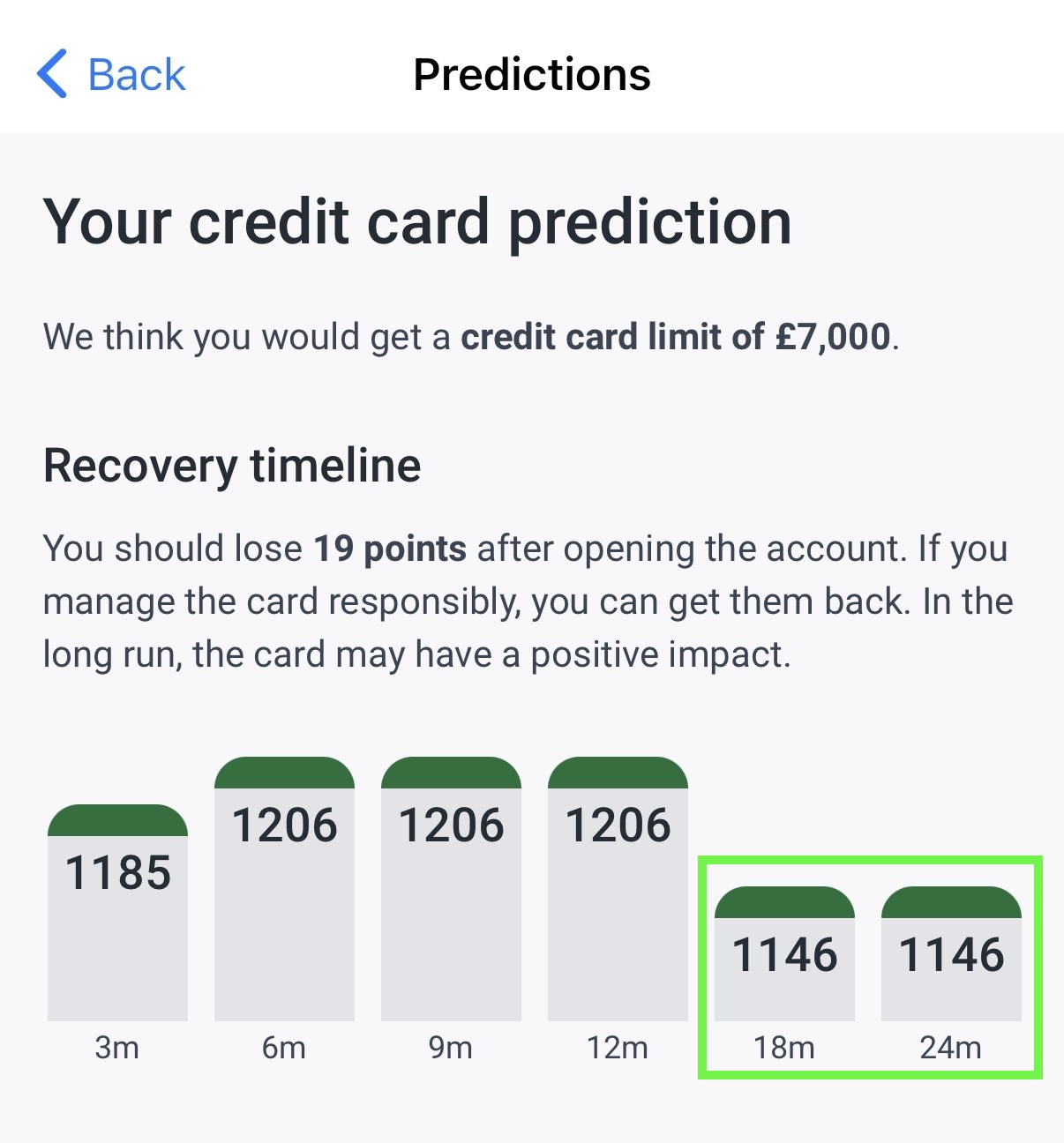
My Experian app recently produced the prediction above. The explanation itself makes sense: if I open a new credit account, I’d initially lose 19 points, then recover those points within three months, and over time the score might go higher than where I started — assuming perfect payment history, low utilisation, and all the usual good behaviour.
Then the timeline goes off a bit. Or a lot.
It recovers and climbs to 1206, which matches what Experian is saying. But then at 18 and 24 months the score suddenly drops to 1146.
That feels like a bug. Based on Experian’s own logic, you’d expect it to hold around 1206 or go higher as the account ages and builds history — what credit nerds call depth. Instead, it drops below my starting point, which doesn’t make sense.
It’s a reminder not to take these tools at face value. They’re only useful if the predictions actually follow the logic they’re based on. This one didn’t.